Category: Reviews

Me reviewing things

  • Book Review Revue Pt. 4

    I went pretty heavy on fiction this time, with a lot of sci-fi. Nerds! Speaking of, I’ve yammered on a lot about e-reader apps in this space, so to add to that I’ll say now that Apple fixed whatever weird bug it was I mentioned last time where hitting the right side of the screen would take you backwards in iBooks. That was bad. It’s no longer so. Good job Jobs’ ghost! I read most of these in OverDrive though which is also great.

    Jay McInerney, Bright Lights, Big City (1984)
    An essay I saw on Salon.com prompted me to look for this one. If it’s the earliest example of this particular form then I can see that it was influential, though the only other book like it that I could think of was the Mysteries of Pittsburg my Michael Chabon. That’s (part of) why I don’t do this for money.

    Erik Larson, Isaac’s Storm (2000)
    I think this is the last of them, of the Erik Larson books I can track down. Big historical event, check. Relatively overlooked persons (historically speaking) with compelling storylines that interweave in unexpected ways with aforementioned historical event, check. Conflict, drama, etc. OK we got a bestseller.

    Daniel Suarez, Daemon (2006); Freedom (2010)
    It’s like the Internet but better. A combination techno-thriller, mystery, and Bildungsroman, if you will. Imagine Google Glass going horribly wrong. Or horribly right, it’s not clear. Very fun reading.

    Ursula K. Le Guin, Voices (2008); Powers (2009)
    The sequels to Gifts, which I talked about last time. Each story focuses on a child/adolescent character dealing with some personal crisis (town occupied by barbarians, being a runaway slave, that sort of thing) who happens also to be coming to terms with a particular supernatural (or at least extraordinary) ability. Eventually each story ties in with characters we met in Gifts. It’s all fine and very Le Guin-y, good times.

    Various authors, Lightspeed: Year One (2011)
    I picked this up (or downloaded, rather) as I was on an Ursula K. Le Guin streak and she has a story in here. Other people do too, and holy crap there are some great stories. And lots of them, this thing took forever to finish. Naturally I didn’t take notes on which stories I liked the best, so I’ll have to go back and pick those authors out. Steven King had a good one. Ursula’s was good too but not the best in here.

    Ursula K. Le Guin, The Dispossessed (1974)
    A classic, apparently, I didn’t know. Interesting to see how Ms. Le Guin’s writing has changed since this early novel. In it she has ideas about authoritarianism versus socialism and plants them on a fictional alien planet and its moon (respectively), imagining that the closest thing you could have to a utopia would necessarily be compromised and not exactly Club Med. Or maybe it is like Club Med? I don’t really know what that is. Anyway, good stuff.

    Charles Stross, The Atrocity Archives (2004); The Jennifer Morgue (2006); The Fuller Memorandum (2010)
    These are fun, and part of what’s fun about them is that you can observe Mr. Stross improve as a writer across this series. Subject-wise they’re kind of like Maisie Dobbs for geeks. They’re mysteries, of sorts, but of the deus-ex-machina James Bond variety where the reader’s not in a position to Hercule-Poireu anything. You’re pretty much just along for the (sometimes unintelligible) ride.

    Richard Dawkins, The God Delusion (2006)
    Dawkins has been painted as the Pope of atheism, as a sort of irreligious fundamentalist, but after finally reading one of his books I don’t think that’s fair. I do think I see where it comes from. First, he is very smart and extremely well-read, knowledgeable through his own decades of research in biology, and kind of a stickler for logic. Those qualities are usually annoying. Second, he seems to take a lot of joy in showing off how smart he is and pointing out exactly where others are misguided. Finally, he has the impetuousness to assert his conclusions against a majority that doesn’t want to hear them. To some this might appear fanatical, but it might just be extremely brave.

    As I progressed though this book my initial impression of Dawkins as a sort of precocious know-it-all was replaced with an image of someone so awed by the workings of the world, particularly the biological world, as revealed by scientific understanding that he is frustrated and saddened by those who refuse to see it for themselves — or worse, those who would deny it for everyone.

    As an aside, it was interesting to note that the world’s most famous atheist claims not to be atheist, insisting rather that he’s technically agnostic. He goes on to point out, however, that agnostically treating religious claims in terms of probabilities makes the distinction more or less irrelevant.

    Charles Stross, Glasshouse (2006)
    This one was just plain badass, with Stross hitting his stride as a writer right about here. I don’t know how many of the ideas in here are original to him. I’m guessing a lot of it is taken from Kurzweil and others’ ideas about the Singularity and post-human futures where technology has caught up with consciousness. Either way it’s fun stuff. Not unlike the Daniel Suarez books reviewed previously, or a lot of Cory Doctorow stories, or William Gibson, or OK so this is fairly well-worn territory. Still, not bad.

    Charles Stross, ???
    At this point I was on a roll with this author, but I read a couple of other things by him that were so hit and miss that they lost me. I don’t remember now what they were, which means it’s time to move on.

    Dan Simmons, Ilium (2003), Olympos (2005)
    Ilium is so bizarrely, wildly weird and creative I was dazzled for a while there. Just describing the premise: a classics professor from Indiana circa 1996 is resurrected hundreds of years in the future by certain Greek gods in order to monitor and record the Trojan war, which seems to be happening on Mars. In the meantime, humans are living on Earth, but not many of them, and they’re kept in a state of idiocy by robots, while not aging (the humans, not the robots — though I guess they don’t age either). Also in the meantime, another bunch of robots are hanging around Jupiter, reading Proust and Shakespeare, and planning a mission to go see what all is happening on on Mars and Earth.

    And it all works, for the most part. As the story goes along (which it does for thousands of pages and on into Olympos) these ideas are spun into some kind of sense. As is the case in a lot of stories that start out showing great promise, however (I’m thinking the TV show Lost, or Mark Danielewski’s House of Leaves), explaining all that great stuff necessarily kills the intrigue and/or becomes tedious and silly. Still, it was overall pretty awesome, and Simmons keeps it interesting in part by showing off a crazy amount of scholarly knowledge of Proust, Homer, and Shakespeare.

    Walter Isaacson, Steve Jobs (2011)
    My brother gave this to me for my birthday, thanks John!

    So, Steve Jobs… this book makes the young Jobs appear much less impressive than his later self. The impression I got of early Jobs is one of a magalomaniacal bully who lucked out big time, meeting the right people with the right talents at the right time and knowing how to exploit them for gain, while also being something of a crybaby.

    Then later, a transformation: into competence. And a remarkable competence at that, along with amazing drive and energy. But still basically a jerk, which, what can you say. Jerks move the world.

    I’m going to stop here because I’ve been taking too long to write these, and I’m way behind.

  • Book Review Revue Pt. 3

    In the 80s my father tried to get his sons to keep track of the books we read in what he called a “book book” (which I just now finally understood — a book of books, I get it), and none of us took him up on it. It took 25 years or so but here’s me doing it now. On the Internet!

    By the way, I’ve been reading a lot on Kindle for iPhone lately and I think it just might be the best reader app. I know I keep harping on readers but there it is. The truth. I hate to say it too because I’m not a big fan of Amazon. They’re just so… convenient. And they made the best reader app. Overdrive is good too though.

    iBooks used to be just about as good, but the latest versions seem kind of buggy. I’m not sure how but sometimes tapping on the right side of the screen takes you back a page. IT SHOULD NEVER DO THAT.

    Neal Stephenson, REAMDE (2012)
    REAMDE feels like a kind of return to form for Neal Stephenson. It’s a lot like Snow Crash, only set in the present, which Stephenson makes to feel like the future. Apart from that it’s a pretty straightforward adventure story, full of the twists and turns and unlikely coincidences and interrelated character paths that characterize Stephenson’s novels. It’s not great writing, but it’s hella fun to read. Yes, I said hella.

    Tom Wolfe, The Electric Kool-Aid Acid Test (1968)
    I had finished Matterhorn, was in the middle of the Lotus Eaters, and had just watched a documentary about Hunter S. Thompson when I picked this one up. I was on this crazy 60’s trip, man, and I particularly liked this one, mainly because the writing is so inventive and the subject matter so bizarre-yet-historically-significant. It’s interesting to see how the inventors of the 60’s counterculture didn’t entirely resemble what they begat. Kesey was a jock! Who knew.

    Tatjana Soli, The Lotus Eaters (2010)
    Gauzy, pretty, excellent novel set among combat photographers in Vietnam. Part of the aforementioned 60’s kick I was on for a while this year.

    James O’Callaghan, No Circuses (1982?)
    In the early 80’s my father wrote a book, and it’s great! The protagonist is the newly-State-Department-appointed director to the cultural center in a fictitious Latin-American country… already very esoteric, and more so since the State Department doesn’t involve itself in those anymore. But for a while there it was a thing, and my father held that position in real life, in Ecuador, though the events in his book are quite fantastical and fun. I’d say to market it toward the NPR demographic. Publishers wanted.

    Suzanne Collins, The Hunger Games (2008); Catching Fire (2009); Mockingjay (2010)
    I wanted to see what all the fuss was about, and I get it, man. The books for young adults are written in such a way that you can’t put them down. It’s another one of those “invent a character and then beat up on him/her for several hundred pages” that I’ve written about several times since I’ve been writing these blurbs. It’s not unusual subject matter for young adults, what is surprising is how dark and brutal, pessimistic and cynical it is. It’s awesome.

    Erik Larson, Lethal Passage (1995)
    So. Guns. I like Erik Larson when he’s telling stories. In this book he has an agenda, which is ok, but it’s less fun reading than, say, In the Garden of Beasts. In his usual way Larson picks a narrative and then weaves a lot of other information into the telling of it — in this case, how a teenager in the 80s got hold of a gun and then used it to shoot up his school. Routine now, I know, but when Larson was writing this it was still a bit shocking, and he explores how it came to be, the history of gun regulation, the rise of second amendment fundamentalism and its lobbying power, and the inability of regulatory agencies to do anything about anything (by design). It all makes a lot of sense and is very depressing, as any and all attempts to talk about reducing harm or even study gun violence are hysterically perceived (by design) as an unholy attack on everything good and decent.

    Since I started reading this book there have been a number of high profile shootings — Justin Ferrari’s death in my neighborhood, the Cafe Racer shootings a bit north of me, a mass killing in Chicago, one in Tulsa, the Aurora movie theater shooting, and now the Sikh temple in Wisconsin. Of course others I can’t remember, and dozens so routine as to not be national news. The big ones are news for a week or a month and then we forget. Then there was the one in Toronto, shocking only because it didn’t happen here, shocking mostly to Canadians, who aren’t yet desensitized to this sort of thing.

    Larson concludes the book with a number of laws that he thinks should be passed that might both protect the rights of gun owners and also prevent the kinds of shootings discussed above. It’s all a lot of nuanced logical wishful thinking that has no place in our political discourse.

    Jon Gertner, The Idea Factory (2012)
    It’s pretty repetitive, but reading this book you come to understand that great things were invented by great men at Bell labs.

    The author spends a bit of time defining the word “innovation,” with the takeaway that corporate capitalism doesn’t often produce real innovation. The distinction drawn here is between optimizing or building upon existing technology (which quarterly shareholder-value-seeking companies do extremely well, and practically all modern “tech sector innovators” are in fact doing) and inventing entirely new revolutionary things (which quarterly shareholder-value-seeking companies can’t risk pursuing, and which practically all modern “tech sector innovators” are not doing).

    AT&T was a regulated monopoly, not beholden to producing quarterly shareholder value, but rather to the mission of expanding and improving phone service (and getting paid for it) within parameters imposed by the government. Perhaps the most important of these parameters was that inventions at AT&T had to be shared, licensed to private business at nominal cost. The nature of intercontinental wired phone service was such that planning and research was conducted on a decades-long timescale, and the company was required to (and had the luxury of doing so within its monopoly) invest in a lot of basic science and research, the results of which were often improved upon elsewhere.

    What then came out of Bell labs is a large subset of modern information technology: the transistor, information theory (courtesy of Claude Shannon), UNIX, C, cellular phones and networks, satellite communications, fiber optics. This tension between true innovation coming from a non-competitive economic dynamic, and optimization resulting from competition, is an interesting one. I imagine we see it all the time in what governments and universities fund/invent and then companies bring to market (I think there’s another book out there exploring how this worked in Silicon Valley), but our dependence on both is not as widely discussed as it should be.

    Erik Larson, The Devil in the White City (2004)
    As mentioned above in regard to his book Lethal Passage, Erik Larson has a schtick. His schtick is weaving disparate but co-incident historical narratives together in a way that’s both informative and entertaining. This one covers a serial killer working Chicago at the time of the 1893 World’s Fair, and goes into detail re: both. That is, how the killer worked, and what all went into making the fair happen, particularly Daniel Burnham’s incredible effort to pull it all off. Good stuff.

    Geraldine Brooks, The People of the Book (2008)
    I picked this up at the cabin my wife and I were staying at on vacation, literally to read on the beach. It turned out to be something of a page turner and I ended up buying a copy. It’s a novel based on the true story of the Sarajevo Haggadah, an illustrated medieval volume that survived centuries of war and inquisition. Brooks invents stories around specific episodes in the book’s history, and she weaves them in brilliantly with the main narrative of the Australian restorer tasked with repairing the book. Lots of twists and turns in this one, and humanizing of Muslims, so if you’re Pamela Geller you might want to skip this one.

    Ursula K. Le Guin, The Birthday of the World and Other Stories (2003)
    I love Ursula K. Le Guin. Her way of telling stories and creating moods is one of a kind. I find it a bit interesting how she seems to only have two modes though: stories about space exploration, and medieval-type fantasy (horses, sailing, magic, that sort of thing). I think she might have some stories set on Earth but I haven’t read them yet.

    The stories in this collection are of the former variety (space), and they’re great. Le Guin focuses on fictional societies which will have certain things in common with those on Earth and certain differences. The differences — in climate, the length of a year, the length of seasons, genders, sex, male to female ratios, race — drive a lot of her imaginings, and in her subtle way encourages the reader to think about how these aspects of ourselves are dealt with in our culture.

    Ursula K. Le Guin, Gifts (2004)
    Following my blurb above, this one is the latter variety (medieval). What is it with wizards and serfs and horses and sword fighting and whatever that continues to inform fantasy writing? I don’t know, but Le Guin imagines these things better than most. A lot of what I said above carries over here. What would it be like if a society was divided into families, each of which possesses a supernatural power passed down through generations that affords some advantage or disadvantage over the other families? Well here you go, read this.

    Erik Larson, Thunderstruck (2006)
    Ok, so obviously I like reading Erik Larson books. I mentioned his schtick in my blurbs above in regard to Lethal Passage and Devil in the White City. This book is essentially the Devil in the White City, but in a different decade, with a different murder, and with Marconi instead of Burnham. Takeaway: Marconi was a dick.

    I was in the middle of reading this when I played at Toorcamp this summer. I was talking to some RF nerds and got into a silly semi-argument with a particularly pompous nerd about Marconi. More precisely, I let him argue and opted not to engage. Later on these nerds were talking about Nicola Tesla, and I said, “Tesla was an underrated band.” The same nerd said, “I wouldn’t say Tesla was underrated. Ok maybe he wasn’t appreciated in his lifetime but now lots of people think he’s great.” I thought I liked nerds but now I remember that they are annoying.

    Michael A. Hiltzik, Dealers of Lightning: Xerox PARC and the Dawn of the Computer Age (2000)
    Dealers of Lightning is a nice complement to The Idea Factory, and ultimately arrives at the same conclusions I mentioned in that blurb. Real innovation occurred at Xerox PARC because very smart people were allowed to pursue research with no strings attached. In this case though it was a shame, as Xerox didn’t seem to understand what was going on at PARC and was too institutionally rigid and bureaucratic to turn PARC’s creations into products. Their several attempts to do so were bungled in the worst way, and even the laser printer, which eventually became wildly profitable for Xerox, was met with official resistance and skepticism all along its path to commercialization.

    Xerox’s loss was everyone else’s gain, including Apple and Microsoft. Former PARCers went on to start 3Com, Adobe, among others.

  • Two Pros at Work

    Yesterday I got to watch a couple of musical geniuses do their thing.

    First, Andrew Bird played an in-studio at the radio station where I work, and I watched for a couple of songs. I’m not strictly an Andrew Bird fan, but he is something to see. For this performance he and his band were assembled around one microphone, old-school radio style, with drums, acoustic bass, and acoustic guitar. Bird himself played fiddle (both fingerpicked and bowed), sang and whistled, effortlessly, perfectly, completely in control but with feeling. It was great, and an awesome thing to watch a professional of that caliber up close.

    Then last night was Radiohead at the Key Arena. A whole lot of talent went into that event, but I make a point to contrast Thom Yorke’s twitchy, sloppy genius with that of Andrew Bird. Very different, but again something to see, wondering which of their eight albums’ worth of amazing songs he’ll pick next. They mostly stuck to their last three albums, and as usual left me wanting more.

    Radiohead 4/9/2012

  • A couple of music documentaries, 30 Rock sighting

    In the last few days I’ve seen a couple of music films that I’d like to remark on.

    Anvil! The Story of Anvil (2008) was something. Documentarians catch up with a somewhat influential (in metal circles) early 80s hair metal band from Toronto that never achieved success but also never quit trying to achieve success. The film opens with scenes from the band’s peak in 1984 playing a metal festival in Japan, followed by scenes of the present day (2006 or so) of the lead singer/guitarist (“Lips”) going to his low-wage day job in Toronto, and then scenes of the band playing their local pub to 100 or so devoted fans.

    At this point I had some conflicting reactions.

    It was heartening to see how good they are. And shocking — had they cut from the 80s concert scene directly to the ’06 concert scene the only difference would be thinning hair and wrinkles. They never stopped playing. Lips and drummer Robb are the original members, in their 50s at this point, still great players (instrumentally at least) and as energetic and present as they were in the 80s. It was also nice to see what kind of support they have in their hometown after 30 years of playing, that 100 people would come out to see them. So what more could you want?

    Sadly, they have a dream, and even thought he object of their dream (80’s hair metal world stardom) no longer exists, the film follows their one last attempt at realizing it. It gets depressing. Quixotic? That’s the word. It’s worth seeing though, you can stream it on Netflix.

    Last night I heard D. A. Pennebaker on public radio’s American Routes discussing Dont Look Back, his 1967 film of Bob Dylan’s 1965 tour of England. The modern age being as awesome as it is, I promptly rented it online.

    I’m on a weird 60s kick right now and Dont Look Back fits into that nicely, and is quite a different music documentary than Anvil. I don’t have a lot to say on it other than the film itself has a great pacing and feel to it, and captures the power of Dylan’s solo performances perfectly. I haven’t spent time with and/or don’t understand later Dylan enough to appreciate the wheezing unintelligible figure he turned into (his MTV Unplugged album was one of the worst things I ever bought), but watching him here is just magic. It’s an honest portrayal (or as honest as something as contrived as an authorized documentary can be), showing an impatient churlish side to the man, in his interactions with the press, etc. Plus, everybody’s smoking! Constantly. The whole thing reminded me a lot of the 1998 Radiohead documentary Meeting People is Easy, which I also really like, and my guess is it isn’t an accident (on Radiohead/Grant Gee’s part, obviously).

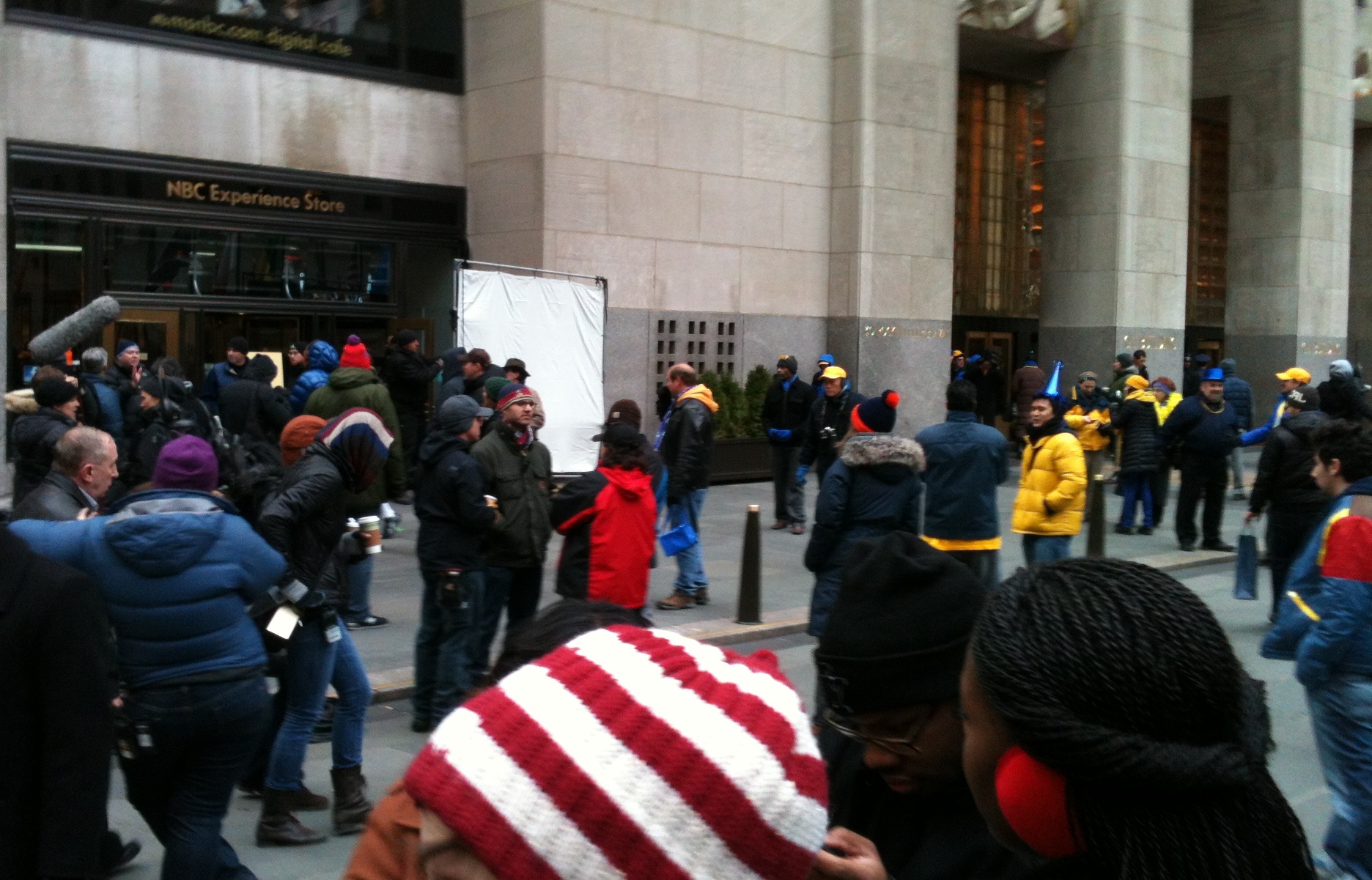
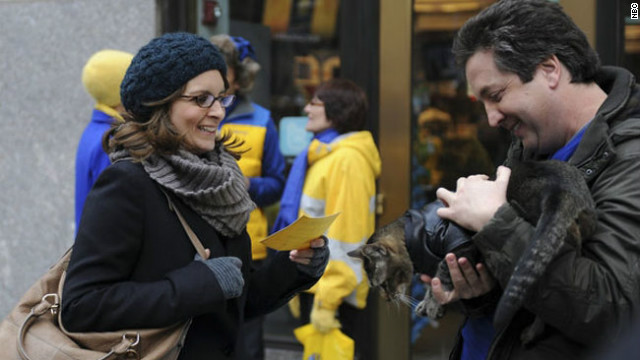
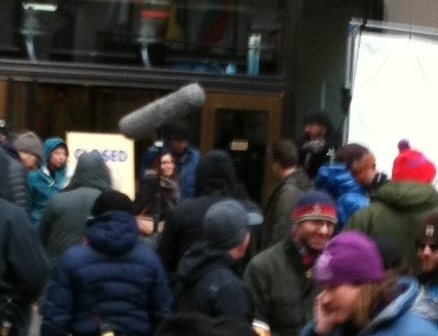
    Scene outside 30 Rockefeller Center during exteriors filming for the show 30 RockSpeaking of TV, the episode of 30 Rock, whose exterior shots allowed me coincidentally to see Tina Fey and Jane Krakowski last month in New York, aired this last Thursday. So it did happen. My photos didn’t turn out that great but you can see people wearing the yellow and blue that forms one of the episode’s very silly plot points. Not their best work, but it’ll do.

    Here’s a photo I found on CNN.com of this scene (on the left), and a photo I took of more or less the same scene (on the right). The whole thing happened very quickly, I don’t think the crowd was there more than 5 minutes. The actors kept appearing and disappearing, and the stage hands kept telling the tourist crowd to stop using flash cameras, and then the whole scene dissipated and everyone left. It was weird.

    30 Rock photo from cnn Tina Fey scene in front of 30 Rockefeller Plaza

  • Book Review Revue Pt. 2

    Before getting into the blurbs, I’d like to take a minute to rag on some reader apps.

    First, Overdrive for iPhone. Overdrive is required by the Seattle public library eBooks collections and is not terrible, but a few things keep it from being truly good. First, images. You can’t zoom in on images at all, which is beyond annoying, particularly if you’ve got charts, any images with text in them, of which A Billion Wicked Thoughts has a few. Second, you can’t select text to copy, and there’s no built-in dictionary if you want to select something and look it up. Finally, and probably worst, the footnotes system is terrible. I downloaded Infinite Jest from the library and couldn’t get too far because you need to be able to navigate footnotes. Instead of each individual note’s link taking you to that note, it takes you to the beginning of the entire notes section. So, clicking on note #34, for example, will take you to note #1, and then you have to advance yourself to 34. This was ok for a while, until I reached a certain note in the book that’s dozens of pages long (a list of the main character’s father’s movie projects). I don’t know if this was the reader’s or the file’s fault, but either way the book became unreadable.

    Worse than Overdrive though is the Google Books reader for iPhone. I bought A Dance With Dragons for this format because one of our local bookstores (the Elliott Bay Book Company) had titles for sale via Google. One of the disadvantages of the eBook format is not being able to support local booksellers, so I thought hey, this is perfect, until I had to use this reader. I think it was version 1.2.0, and what a piece of crap.

    Two main problems: the reader is very slow, and it routinely gets stuck such that you can only advance the pages, and not go back, or vice versa, depending on how you’re reading. The way this becomes most noticeable is, say you read through a passage and want to go back a page or two to review something. Good luck to you sir! The reader might let you page back, but it will be slow about it, and once you’ve paged back it won’t let you page forward again (this is particularly true across chapter boundaries). You can work around it by paging back some more, then paging forward again, but you’ll have to stare a the “spinny” icon for a while while the app decides what to do. Truly awful. I suspect that the length of the book was a factor (it’s a pretty long book), because otherwise I don’t see how Google could release such a lame app.

    As with Overdrive, you also can’t zoom into images or highlight/copy/look up text. The next thing I read was back in iBooks. What a difference. I’d love to buy more eBooks from Elliott Bay but I won’t do it until Google fixes their reader.

    At any rate:

    George R. R. Martin, A Storm of Swords (2000), A Feast for Crows (2005), A Dance with Dragons (2011) – A
    What I said the last time still applies. This series is addicting, and reads so fast you hardly notice how damn long it is. Reading these back to back kept me in a dark place for a while though, and I was glad to be done with them. I don’t mind having to wait however many years for the next one.

    W. Craig Reed, Red November (2011) – B+
    This one’s a pretty fascinating and enjoyable read about submarine warfare during the Cold War. I was a bit of a submarine buff in my teens (I played many hours of Gato) and it was fun to relive that for a bit (I looked at a lot of Wikipedia while reading this). You get a nice overview of the events, brinksmanship, and technology of the era, some of it widely known and some that’s relatively newly revealed.

    Ogi Ogas & Sai Gaddam, A Billion Wicked Thoughts (2011) – C
    Sex! Now that I have your attention, these authors attempt to bring together theories of male and female sexual desire with an analysis of what people search for and look at on the web. It’s all pretty interesting, though maybe too ambitious and probably full of crap. Reviews by people who know something about the science find a lot not to like, but as far as facts are concerned vs. analysis or explanation, it’s probably still a good read.

    Anthony Summers & Robbyn Swan, The Eleventh Day (2011) – A-
    Given what an effect 9/11 has had on American decision-making and world events in general in the last decade, you’d think the facts in the case would be more settled and widely understood. Summers and Swan do a good job laying out the known knowns and unknowns as well as the ways in which these differ from the popular understanding. The results are quite surprising and generally exasperating.

    I do wish the authors had spent more time refuting conspiracy theory. That section of the book may be the weakest; it doesn’t cover all of the most popular assertions and it often appeals to emotion rather than sticking to evidence. Still the book is worth reading.

    Stieg Larsson, The Girl With the Dragon Tattoo (2008), The Girl Who Played With Fire (2009), The Girl Who Kicked the Hornet’s Nest (2010) – A
    I wanted to know what all the fuss was about, and now I get it man, I get it. I picked these up (electronically, thanks everyone for the iTunes gift cards) and couldn’t put them down.

    The story is kind of like Buffy the Vampire Slayer meets Ender’s Game. Larsson invents a fantastical cyber-punk heroine to beat the crap out of and later reward by letting her realize some elaborate revenge fantasies. The big theme is female empowerment within a male-chauvinist Swedish culture, though it’s a bit hard to take seriously when the male hero is a cartoonish womanizing action-nerd.

    There are other themes, the most interesting is Larsson’s commentary on journalism, first specifically regarding economic journalism’s stenographic tendencies in Dragon Tattoo, at least five years before Jon Stewart’s Jim Cramer takedown. This builds into a larger statement on the power and responsibility of investigative journalism to uncover abuse and corruption, and modern journalism’s abdication of this responsibility. This, years before Stephen Colbert’s White House Correspondents Association dinner speech, which was when a lot of us became more aware of it. Clearly these have been issues for a while but Larsson may have been more prescient than most.

    Karl Marlantes, Matterhorn: A Novel of the Vietnam War (2011) – A+
    We’ve all seen Vietnam war movies like Platoon or Full Metal Jacket that depict the misery of that period. Matterhorn is something else. Obviously a book can only go so far in portraying the war experience, but I’ve not seen or read anything else that gave a better sense of the tactics, weapons, operations, routines, emotions, and politics that a Vietnam-era soldier (or Marine, in this case) would have dealt with. It’s an inspired work, not to mention a page-turner.

    Matthew B. Crawford, Shop Class as Soulcraft: An Inquiry Into the Value of Work (2009) – B
    Most everyone will find something to like in what Crawford has to say regarding the cult of college, the empty promise of a future where we are all fancy “creative class” knowledge workers (in the States at least), and the increasing disconnect between how one earns a living and what gives one meaning. Everyone might not like the way he says it though… it’s a bit of a dry, academic, philosophical treatise (which is a bit ironic given his general contempt for academics). The best parts are anecdotes from the author’s experience as a mechanic and electrician, and these are often in the footnotes. I took exception with one or two of his arguments at some point, but I forget now what they were, and I don’t care enough to go back and figure it out. So let’s call it good.

    That’s all for now. On a whim I just “graded” these books. My criteria are a combination of how well-written I think the book is and how much fun it was to read, and I have 3 seconds to decide.